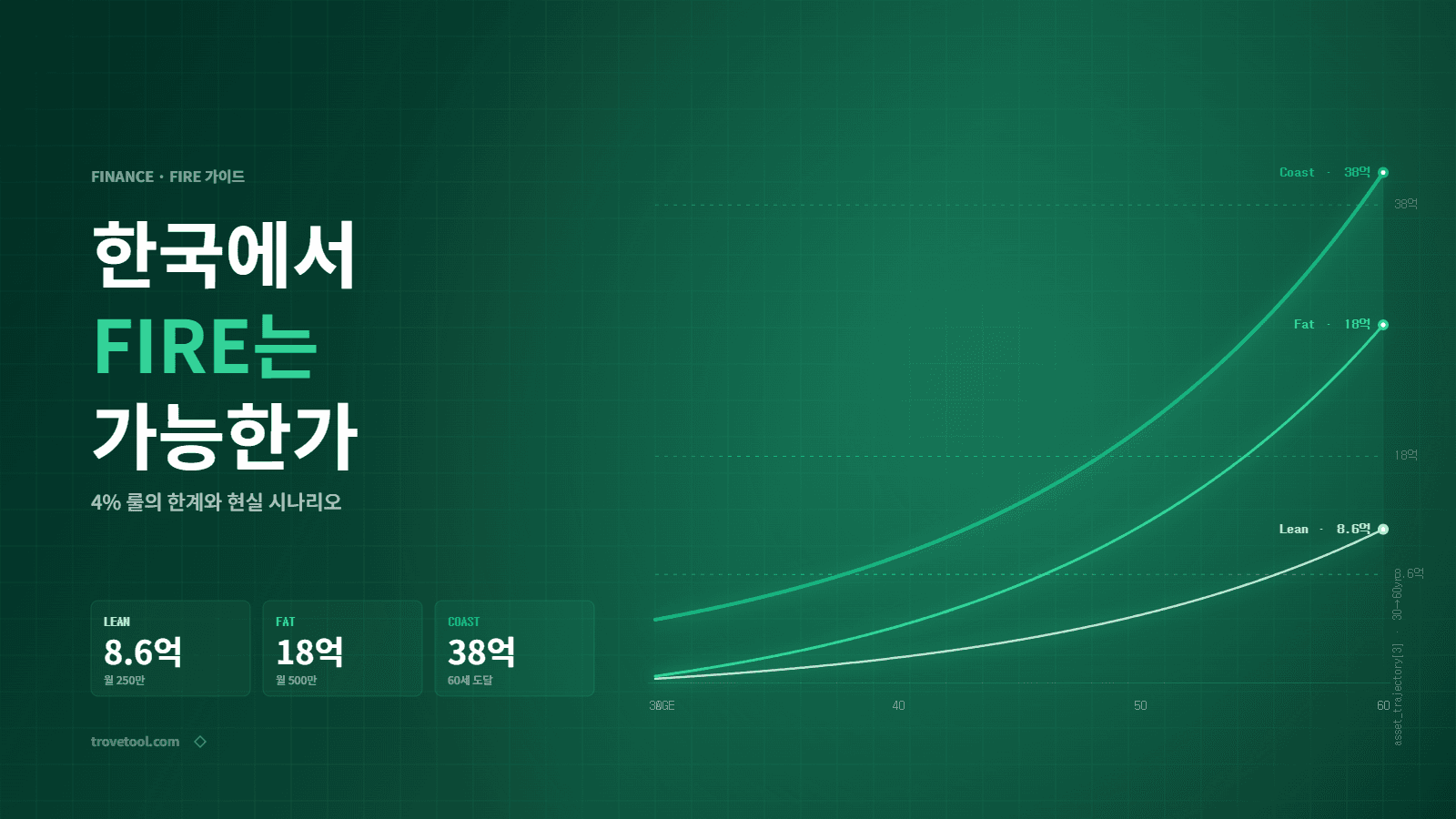
FIRE (Financial Independence, Retire Early) is built on the 4% rule: save 25 times your annual expenses and you can live off withdrawals indefinitely. But this number comes from a safe-withdrawal-rate study by three Trinity University professors, validated on U.S. market data from 1926–1995 (Trinity Study overview, Wikipedia). Can you apply it directly in Korea? The short answer: not without adjustments. This article walks through exactly where the 4% rule breaks down in Korea, and—with real numbers—what target a Korean salaried worker should realistically aim for.
This article is for informational purposes only and is not investment or tax advice. Consult a tax advisor or financial professional for your personal situation.
Updated (2026-08-17): Revised for Korea's 2026 tax reform bill (a government proposal announced in late July–early August 2026) — a new section covers what the major-shareholder capital-gains rollback and the securities-transaction-tax hike mean for the withdrawal phase. Also refreshed: health-insurance dependent criteria and Korea's enacted pension reform (premium rate 9.5% → 13%). Reform-bill figures can still change during National Assembly review in December.
What the 4% Rule Assumes — and Where "25×" Comes From
The original Trinity study found that, with a portfolio of 50–75% stocks, withdrawing 4% per year had a 95%+ chance of not depleting over 30 years. The assumptions baked into the 4% rule are therefore:
- 30-year retirement (retiring in your 60s)
- 50–75% stocks / 25–50% bonds portfolio
- ~7% nominal annual return, ~3% inflation
- Healthcare mostly covered by insurance
- Owning your own home
For Koreans targeting FIRE in their 30s or 40s, almost none of these hold. Retirement may last 50+ years, out-of-pocket healthcare costs are significant (real-loss insurance renewals + co-pays), and most households rent rather than own.
It helps to see where the "25×" actually comes from. The 4% rule is just the inverse of a 4% withdrawal rate: 1 ÷ 0.04 = 25. To withdraw 40M KRW/year at 4%, you need 40M ÷ 0.04 = 1B KRW. Lower the rate to 3.5% and you need 1 ÷ 0.035 ≈ 28.6×; at 3.0%, 33.3×. A 0.5-percentage-point change in the withdrawal rate swings your target by hundreds of millions of won.
Korean Reality: Spending Structure and the Hidden "Health-Insurance" Cost
An average Korean family of four spends around 4.5–5.5 million KRW per month (2025 figures):
- Housing (maintenance, taxes, repairs): ~800K KRW
- Food: ~1.3M KRW
- Transportation & communication: ~600K KRW
- Education (1–2 children): ~1M KRW ← high variance vs. the U.S.
- Medical & health: ~500K KRW
- Leisure & misc: ~800K KRW
Education is the wildcard. Private tutoring plus four years of private university tuition (~40M KRW) can easily add the equivalent of 2M KRW per year in extra spending for 20 years post-retirement.
There's one more Korea-specific cost the American FIRE formula barely captures: National Health Insurance premiums (건강보험료). When you quit your job and lose earned income, you switch from an employee-insured to a regional-insured (지역가입자) status—and regional premiums are scored not only on income but also on your assets (home, financial holdings) (National Health Insurance Service, regional-subscriber assessment). Premiums are computed as "income points + property points" times a per-point amount, so the more wealth you've accumulated for FIRE, the higher your property score and the higher your monthly premium—which can run to several hundred thousand won. Leave this out of annual spending and you fall into the trap of "I retired, but my fixed costs went up."
There is one escape hatch. If your spouse or child is an employee-insured subscriber, you can register under them as a dependent (피부양자) and pay no premium at all. The catch is the eligibility bar: annual combined income of 20M KRW or less and a property-tax base of 540M KRW or less (in the 540M–900M band, income must stay under 10M KRW) — and, critically, once financial income (interest + dividends) exceeds 10M KRW a year, the entire amount counts as income, not just the excess. It's a cliff, and dividend-income FIRE retirees are exactly the people who trip over it. The full criteria and defense strategies are covered in Korea's Health-Insurance Dependent Rules 2026.
Korean FIRE Target Assets — A Comparison Table by Type
The same word "FIRE" can mean a target that differs by 2× depending on lifestyle. Converting monthly spending with the 4% rule (×25) and the more conservative 3.5% rule (÷0.035):
| Type | Monthly spend | Annual spend | 4% rule target | 3.5% rule target | Best fit |
|---|---|---|---|---|---|
| Lean FIRE | 2.5M KRW | 30M KRW | 750M KRW | 860M KRW | Regional, own home, kids independent, minimalist |
| Regular FIRE | 3.75M KRW | 45M KRW | 1.13B KRW | 1.29B KRW | Metro outskirts, average lifestyle |
| Fat FIRE | 5M KRW | 60M KRW | 1.5B KRW | 1.71B KRW | Metro, raising kids, comfortable margin |
- Lean FIRE: Regional living, own home, children independent. Annual expenses of 30M KRW need 750M KRW at 4%, or 860M KRW under the safer 3.5% rule.
- Fat FIRE: Metro living, raising children, comfortable healthcare and leisure. Annual expenses of 60M KRW: 1.5B KRW at 4%, 1.71B KRW at 3.5%. For a 50-year retirement, 1.8–2B KRW is recommended.
- Coast FIRE: Accumulate enough now that—without additional contributions—it grows to your target by age 60. Example: 500M KRW at 30, compounding at 7%, reaches ~3.8B KRW over 30 years; then enter the withdrawal phase.
Whether you can genuinely live on 2.5M KRW/month or actually need 5M KRW—that single line determines the savings intensity of your next 10–20 years.
Your Savings Rate Decides Your Years to Retirement
The real lever in FIRE isn't return rate—it's your savings rate. A high savings rate has a double effect: (1) you accumulate faster, and (2) the nest egg you need is smaller in the first place (because you spend less). Assuming a 5% real return (after inflation), starting from zero, and retiring under the 4% rule, the rough years to retirement by savings rate look like this:
| Savings rate (of take-home) | Approx. years to retirement |
|---|---|
| 20% | ~37 years |
| 30% | ~28 years |
| 40% | ~22 years |
| 50% | ~17 years |
| 60% | ~12.5 years |
| 70% | ~8.5 years |
These figures are approximations assuming a 5% real return, the 4% rule, and a starting balance of zero. Different returns, taxes, or starting assets change the result substantially, so run your own numbers.
The message is clear: the person with the higher savings rate—not the higher salary—retires first. At a 40% savings rate, roughly 22 years; at 50%, roughly 17 years. So the first gate of FIRE isn't choosing investments—it's "how high can I push my savings rate?"
Common Mistakes Applying FIRE in Korea — A Checklist
These are the items most often missed when calculating a Korean FIRE number. If any is a "no," recheck your target assets.
- Did you set the withdrawal rate to match your retirement length, not just 4%? For 50+ year retirements, 3.0–3.5% is realistic. Remember the 4% rule assumes 30 years.
- Did you add regional health-insurance premiums to annual spending? Premiums are levied on your property score even with no income—the most commonly forgotten fixed cost after retirement (National Health Insurance Service).
- Did you factor capital-gains and dividend tax into your withdrawals? Gains on selling overseas ETFs are taxed at 22% (with a combined domestic-plus-foreign basic deduction of 2.5M KRW/year); dividends face aggregate or separate taxation (National Tax Service, foreign-stock capital gains tax). Pre-tax withdrawals and after-tax take-home differ.
- Did you subtract inflation from the nominal return? "7% return" is nominal; subtract 3% inflation and the real return is 4%. Future spending rises with inflation.
- Did you secure a USD asset allocation? Single-currency (KRW) exposure is exchange-rate risk for a long-horizon retiree.
- Did you count the National Pension as only a "bonus"? For those born 1969 or later, old-age pension begins at 65 (National Pension Service), so you must survive the gap before that on assets alone. Note that Korea's pension reform, passed in 2025, raises the premium rate from 9.5% in 2026 by 0.5pp each year to 13% by 2033, with the income-replacement rate set at 43% (NPS pension-reform guide) — both your pre-retirement contributions and your projected benefit have shifted, so rerun the numbers against Korea's 2026 National Pension changes, and still leave a safety margin for changes in amount and timing.
- Did you budget large irregular costs—kids' education, weddings—as separate line items? Blending them into average monthly spending underestimates them.
How much tax affects your after-tax withdrawals in the decumulation phase is covered in Dividends vs. Selling: A Tax Comparison, and how much inflation inflates future spending you can check directly with the Inflation Calculator.
Real Example: A FIRE Roadmap for a Korean in Their 30s
30-year-old salaried worker, annual income 70M KRW, monthly savings 3M KRW, targeting Fat FIRE at 50 (1.8B KRW):
- Current assets: 100M KRW, adding 3M KRW/month, 7% annual return
- After 20 years: ~1.94B KRW (compound growth + contributions)
- Enter withdrawal phase at 50, sustainable spending ~68M KRW/year at the 3.5% rule
- National Pension kicks in at 65 → bridge the 50–65 gap with assets, then a safety margin
The keys are a savings rate above 40% and maxing out tax-advantaged accounts. Consistently saving 40% of your income for 20 years is the actual entry condition for FIRE.
Here's what "maxing out tax-advantaged accounts" concretely means in Korea: first fill the tax-free / separate-taxation limits of an ISA (Individual Savings Account, Korea), then use a pension savings account (연금저축) and IRP (Individual Retirement Pension) to claim tax credits on up to 9M KRW/year, and finally invest leftover funds in taxable accounts such as overseas ETFs—in that order. At the same return, the 30-year gap between a taxed account and a tax-free one runs into hundreds of millions of won. For the raw compounding effect of regular contributions, see The Magic of Compound Interest; to design post-retirement cash flow from dividends, see Building a Monthly-Dividend ETF Portfolio.
The Withdrawal Phase: How to Draw Down Your Assets
In FIRE, designing the drawdown (decumulation) phase matters as much as the accumulation. The same 1.8B KRW can run dry by 60 or keep growing past 90 depending on how you withdraw.
- Fixed-amount vs. fixed-percentage withdrawals: The 4% rule takes 4% in year one and then increases only with inflation (a fixed, inflation-adjusted amount). A fixed-percentage approach—withdrawing 4% of the current balance each year—automatically makes you spend less in bad markets, lowering ruin risk, but your spending fluctuates accordingly.
- The first five years decide your fate (sequence-of-returns risk): If the market crashes in the first five years right after retirement, the same average return can still push your portfolio into an unrecoverable spiral. The counter is a cash-buffer strategy: keep 2–3 years of living expenses in cash or short-term bonds, and in a crash spend that cash instead of selling stocks.
- Dividends + selling, mixed: Covering all living costs with dividends alone requires a larger portfolio. In practice, a hybrid—taking some income from dividends and filling the rest by "self-dividending" (selling a portion when needed)—is often more favorable for taxes and flexibility.
Which order to draw down retirement accounts (pension savings, IRP, DC/DB) for the best tax outcome is covered in detail in Retirement Pension: DC vs. DB.
What Korea's 2026 Tax Reform Bill Changes for FIRE
In late July–early August 2026, the Korean government announced its 2026 tax reform bill, and several items bear directly on the FIRE withdrawal phase (Ministry of Economy and Finance, 2026 tax reform announcement). It is still a government proposal awaiting National Assembly approval — figures can change before final passage in December — but you need the direction now to plan scenarios.
- Major-shareholder capital-gains threshold rolled back from 5B to 1B KRW (proposed): The threshold for being deemed a "major shareholder" in a listed stock returns to 1B KRW per stock. Hold 1B KRW or more of a single name on the year-end record date and the following year's gains on selling that stock are taxed at 20–25% (22–27.5% including local tax). The assumption that "domestic listed-stock gains are tax-free" — a premise many Korean FIRE withdrawal plans rest on — breaks for concentrated positions. Above 1B KRW in assets, diversifying across names becomes tax-risk management in itself.
- Securities transaction tax heading from 0.15% back to 0.2% (proposed): The cost of "self-dividending" (selling as needed) rises slightly. Negligible if you rebalance once or twice a year; worth recomputing if you fund living costs through frequent sales.
- Dividend separate taxation is already in effect (2026–2028, temporary): Separate from the reform bill, a special provision passed in December 2025 lets dividends from qualifying high-payout Korean listed companies be taxed separately at 14–30% instead of being aggregated into progressive rates. For dividend-cash-flow FIRE, this changes after-tax income — the qualifying conditions and break-even math are covered in Korea's Dividend Separate Taxation 2026.
- The 24% income-tax bracket ceiling moves from 88M to 92M KRW (proposed): A small cut (up to roughly 440K KRW a year) for high earners still in the accumulation phase. Not big enough to move your FIRE date.
FIRE Isn't a Magic Formula
FIRE isn't really about quitting work early—it's about buying the freedom to choose your work. What you'll do after retirement matters as much as how much you need to save. The regret most 50- and 60-somethings express is not a lack of money, but a lack of purpose.
So while building your FIRE portfolio, also invest in side projects, hobbies, and community outside your main job. You'll stay closer to the original meaning of financial independence rather than just early retirement. It's also worth remembering that even a little side income (so-called Barista FIRE) dramatically reduces the assets you need: an extra 1M KRW/month is equivalent to roughly 300M KRW in assets under the 4% rule.
Calculate Your FIRE Number
Want to plug in your own spending, return rate, inflation, tax rate, and starting assets to see when you can retire? Use the FIRE calculator—it simulates Standard / Coast modes and the Lean·Regular·Fat tiers.
Want to visualize your asset accumulation curve right now? Try the compound interest calculator alongside it.
If you want to design specifically how much dividend cash flow you'll get in retirement, try the dividend simulator.
Wrap-up
In Korea, the 4% rule is a starting point, not the answer. For 50+ year retirements, lower the withdrawal rate to 3.0–3.5%, and be sure to fold regional health-insurance premiums, overseas-ETF capital-gains tax, and inflation into your annual spending and withdrawals. Target assets range from the Lean ~860M KRW to Fat 1.71B+ KRW depending on lifestyle—and what gets you there fastest is not your salary but your savings rate.
FIRE is a lifestyle choice, not an absolute formula. The numbers here are based on average assumptions and are for informational purposes only—not investment or tax advice. Items from the 2026 tax reform bill can change until the National Assembly finalizes them. Consult a tax advisor or financial professional for your personal situation. (Last updated: 2026-08-17)
References
- Trinity Study — Trinity study concept and results (Wikipedia)
- National Health Insurance Service (국민건강보험공단) — Regional-subscriber assessment system
- National Tax Service (국세청) — Capital gains tax on stocks / foreign stocks
- National Pension Service (국민연금공단) — NPS official website
- National Pension Service (국민연금공단) — Pension-reform guide (premium rate and replacement rate)
- Ministry of Economy and Finance (기획재정부) — 2026 tax reform bill announcement