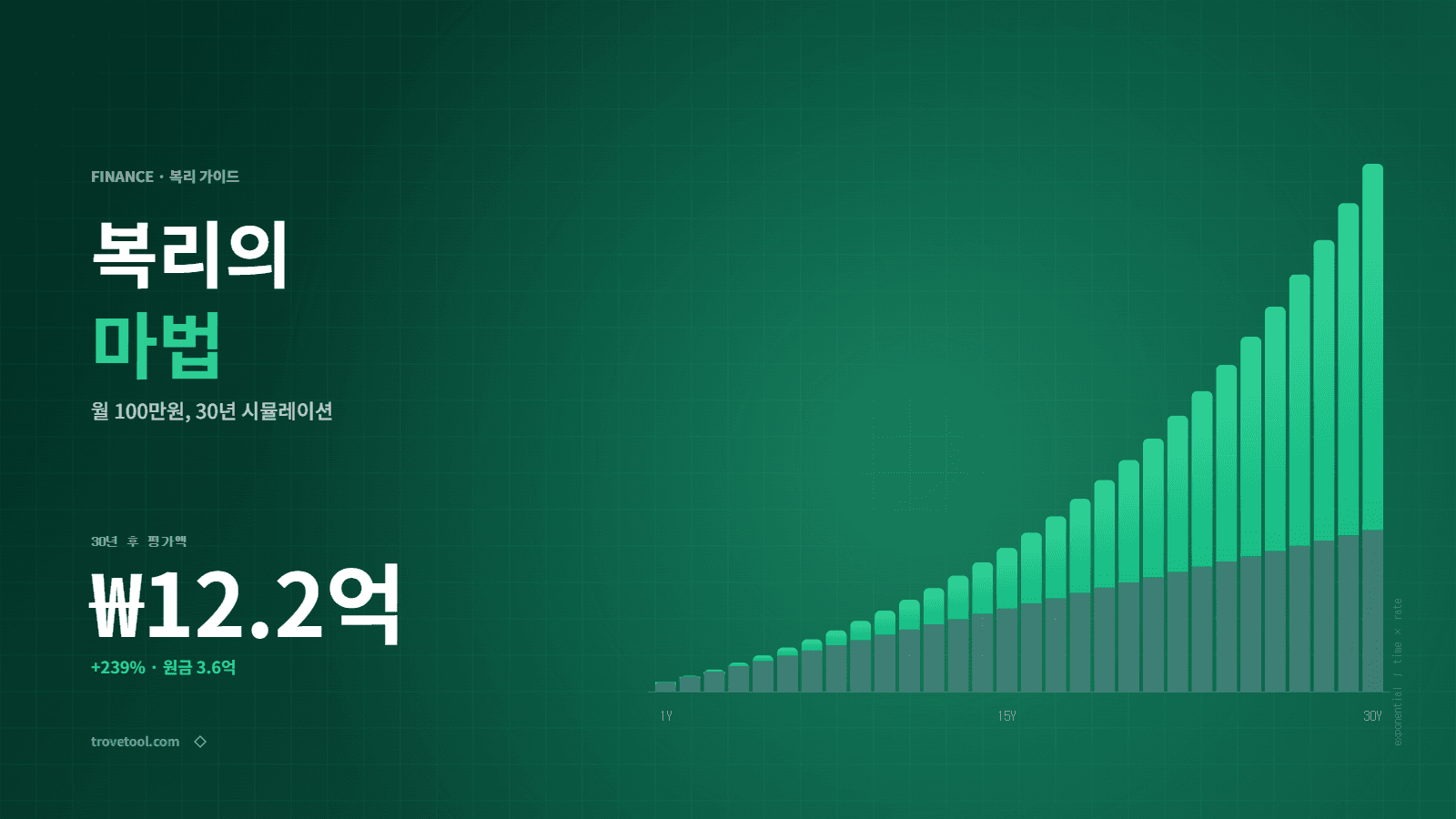
If you save ₩1,000,000 per month for 30 years, how much do you end up with? Sum it up and you get ₩360M. But if that money grows at 7% per year, the outcome is completely different. This post explains, in numbers, why "compound interest" keeps coming out of Warren Buffett's mouth — not with platitudes, but with actual simulation figures.
This post is for informational purposes only and is not investment or tax advice. The figures are simulation estimates based on assumed inputs; your actual returns and taxes depend on your situation and the market. Reviewed and updated on August 17, 2026 against the latest Bank of Korea policy rate (2.75%), actual inflation data, and the 2026 Korean tax reform proposal.
Compound = "Interest on Interest"
Simple interest accrues on the principal only. Park ₩100M at 5% simple interest and you gain ₩5M every year — exactly. After 10 years, ₩150M. Linear.
Compound interest turns yesterday's interest into today's principal. The ₩5M earned in year 1 becomes part of the year-2 base, and the same 5% applies on top of it. Stretch this 30 years and the gap explodes.
Simple:    100M × (1 + 0.05 × 30)        = 250M
Compound:  100M × (1 + 0.05)^30          ≈ 432M
Same principal, same rate, same horizon. The result differs by 1.7×. The key point is that this 1.7× builds up quietly across 30 years. At year 5 and year 10 the gap is small and barely noticeable — which is exactly why most people quit halfway.
Compound Is a Function of Time — The Rule of 72
The fastest intuition tool for compounding is the "Rule of 72." Divide 72 by your annual return (%) and you get the number of years it takes your money to double.
| Annual return | Years to double | Doublings in 30 years |
|---|---|---|
| 4% | 18 years | ~1.6× |
| 6% | 12 years | ~2.5× |
| 8% | 9 years | ~3.3× |
| 10% | 7.2 years | ~4.1× |
When the return goes from 4% to 8% — a "2× increase" — the number of doublings in 30 years rises from 1.6 to 3.3. One extra doubling means the final result itself doubles again. That's why a return gap that looks small compounds into a huge difference over the long run. This is the real meaning of "compounding is multiplication, not addition."
Monthly DCA Compounding — Where the Magic Really Starts
Most people can't drop ₩100M in one go. But ₩1M every month — that's doable. What happens when each month's contribution starts compounding the moment it lands?
7% annual return, ₩1M monthly, 30 years. Total contributions: ₩360M. The compound result: about ₩1,220M (≈ ₩1.22B). Which means ₩860M is pure growth — more than 2× what you put in.
Break it down by horizon and the acceleration shows.
| Horizon | Cumulative principal | Pre-tax value | Growth (value − principal) |
|---|---|---|---|
| 10 years | ₩120M | ₩173M | ₩53M |
| 20 years | ₩240M | ₩521M | ₩281M |
| 30 years | ₩360M | ₩1,220M | ₩860M |
At year 10 the growth is only ₩53M. But at year 20 it's ₩281M, and at year 30 it's ₩860M. The growth created in the last 10 years (year 20→30) is ₩700M — more than the entire first 20 years combined. The real explosion of compounding comes in the back half. That's why "holding to the end" matters even more than "starting early."
Start Date vs Contribution Amount — Which Is Stronger?
A common belief: "I'm tight now, so I'll invest a lot once I earn more." Let's test it with numbers. Both run to age 60, both assume 7% annual return.
- A: ₩500K/month from age 25 (35 years) → about ₩900M
- B: ₩1M/month from age 35 (25 years) → about ₩810M
A contributes only half each month, and A's total contributions (₩210M) are less than B's (₩300M). Yet A ends up with more. Starting 10 years earlier beat "contributing twice as much per month." Compounding built by time is hard to catch up to with extra contributions. In wealth-building, the most expensive mistake is delaying the start.
Don't Forget Korean Taxes
In Korea, interest on bank deposits and dividend income is automatically withheld at 15.4% (14% income tax + 1.4% local income tax) (National Tax Service, withholding overview). For overseas and US ETFs, capital gains tax runs 22% (20% income tax + 2% local) after a ₩2.5M annual basic deduction (National Tax Service, capital gains tax on shares), and US ETF dividend distributions get a 15% local withholding upfront. ₩1.22B "before tax" and "after tax" are not the same number.
These assumptions still hold as of August 2026. The government's 2026 tax reform proposal, unveiled in late July (a government draft — not yet passed by the National Assembly), reshapes inheritance tax and rolls the "major shareholder" threshold for listed stocks back from ₩5B to ₩1B, but it leaves this post's backbone untouched: the 15.4% withholding on interest/dividends and the ₩2.5M deduction + 22% structure for overseas ETFs. For long-term monthly investors, the tax premise is unchanged. There are new variables, though — from 2026, dividends from qualifying high-payout Korean listed companies can opt into separate taxation capped at 30% instead of aggregate taxation (see the 2026 dividend separate-taxation guide), and the bill raising the ISA tax-free limit to ₩5M is still pending in the National Assembly (not confirmed) — the confirmed-vs-proposed split is laid out in the 2026 ISA reform guide.
Apply 15.4% tax to the growth portion (a simplifying assumption) and the ₩1.22B drops to about ₩1.09B — ₩130M evaporates as tax. This is exactly why tax-advantaged Korean accounts — ISA (Individual Savings Account), 연금저축 (pension savings), IRP (Individual Retirement Pension) — are powerful for long-term investing.
Look at it after tax and the difference of "how much you contribute" gets sharper. (7% annual, 30 years, 15.4% tax on growth assumed)
| Monthly amount | Cumulative principal | Pre-tax value | After-tax value |
|---|---|---|---|
| ₩300K | ₩108M | ₩366M | ₩326M |
| ₩500K | ₩180M | ₩610M | ₩544M |
| ₩1M | ₩360M | ₩1,220M | ₩1,088M |
| ₩2M | ₩720M | ₩2,440M | ₩2,175M |
Even ₩300K a month tops ₩320M after tax over 30 years. The point is not to wait for the "perfect amount" but to start with "what you can do now." For how to use tax-advantaged accounts, dig deeper in the ISA tax-saving guide.
Inflation — The Real Enemy
Will ₩1.22B in 30 years be worth ₩1.22B today? No. The Bank of Korea's inflation target is set at 2% on a consumer-price-index basis (Bank of Korea, inflation targeting), and actual inflation can run above it in any given year. Korea's actual CPI rose 2.1% in 2025 (e-Index — CPI growth rate), so this post's 2.5% assumption is deliberately a touch pessimistic. At 2.5% annual inflation, the purchasing power of money shrinks to about 47.7% of today's value over 30 years. That ₩1.22B in the future buys roughly ₩570M worth of stuff at today's prices.
This is why "real value" matters. Subtract inflation (2.5%) from nominal return (7%) and you get a real return of about 4.5%. That's the speed at which your wealth actually grows. Apply both tax and inflation, and the 30-year real purchasing power looks like this. (₩1M/month, 7% annual, 15.4% tax on growth, 2.5% inflation assumed)
| Horizon | Pre-tax value | After-tax value | After-tax real value (today's money) |
|---|---|---|---|
| 10 years | ₩173M | ₩165M | ₩129M |
| 20 years | ₩521M | ₩478M | ₩292M |
| 30 years | ₩1,220M | ₩1,088M | ₩518M |
Nominally it's ₩1.22B, but strip out tax and inflation and convert to "today's money" and it's about ₩518M — still 1.4× the ₩360M you contributed. The point isn't avoiding inflation but beating it.
"Can't a bank deposit do that?" Check it against August 2026 reality. The Bank of Korea raised its policy rate from 2.50% to 2.75% on July 16, 2026 (Bank of Korea — base rate history). Even granting a generous 3.0% time-deposit rate that tracks it, the 15.4% interest tax leaves you about 2.54% after tax. Subtract actual inflation (2.1% in 2025) and your real return is roughly +0.4% a year — lock ₩100M in a deposit for a year and your real purchasing power grows by about ₩400K. Deposits preserve money; they don't grow it. A 7% compound return lives in long-term index investing, not in savings accounts — which is exactly what this post's simulation assumes. You can see exactly how inflation erodes your money with the inflation adjuster calculator.
Common Mistakes — 5 Ways to Kill Compounding
Compounding is a game where "holding" is everything. These five kill it most often.
- Early withdrawal: You cash out at year 5 to buy a new car. You're surrendering the entire, most valuable post-year-10 compounding.
- Market timing: You stop in a downturn and re-enter after recovery. Plenty of research shows that missing just the market's best few up-days can roughly halve your return.
- Chasing returns: 7% a year is plenty, but you chase "30% a year" and lose principal. Compounding is multiplication, so one −50% erases two +25% gains.
- Ignoring tax: You fill a regular account while leaving tax-advantaged limits (ISA / 연금저축 / IRP) unused. Over 30 years the tax difference alone runs into hundreds of millions of won.
- Letting fees slide: A 1.5% fund vs a 0.1% ETF. Compounded over 30 years, the fee gap grows into tens of millions to over ₩100M.
Action Checklist
- Set up auto-debit (fixed date, fixed amount — don't watch the market)
- Fill tax-advantaged limits first (ISA → 연금저축/IRP → regular account)
- Favor low-cost index ETFs (total expense ratio ~0.1–0.3%)
- Rebalance once a year; otherwise "don't touch it"
- Pre-accept a −30% drawdown scenario (if you can't stomach it, dial down allocation)
So How Do You Start?
- Time beats amount: as shown above, ₩500K/mo for 35 years beats ₩1M/mo for 25 years.
- Tax-advantaged first: max out ISA / 연금저축 (Korean retirement) before going to a regular brokerage account.
- Index ETFs: KODEX200, S&P 500, ACE US S&P 500 — historical 7~10% expected return.
- Auto-debit: don't try to time the market. Same day, same amount, every month.
- Don't touch it: compounding lives on holding. Over 30 years you will see at least one −50% drawdown. Survive it.
Curious when the money you accumulate reaches financial independence? Reverse-engineer your retirement date with the FIRE in Korea guide and the FIRE calculator. And turning that accumulated wealth into monthly cash flow continues in building a monthly-dividend ETF portfolio.
Try the Numbers Yourself
Want to plug in your own contribution, horizon, return, tax, and inflation? The graph updates the moment you type. You can immediately see how the "pre-tax → after-tax → real value" flow in the tables above changes with your own numbers.
Open the compound calculator →
This post is for informational purposes only, and the figures are simulation estimates based on assumed inputs. Actual returns and taxes vary by market conditions, product type, and your personal tax bracket. Consult a tax or financial professional for important decisions.
References
- National Tax Service (국세청) — Withholding overview (interest & dividend income)
- National Tax Service (국세청) — Capital gains tax on shares (domestic & overseas)
- Bank of Korea (한국은행) — Inflation targeting (2% CPI target)
- Bank of Korea (한국은행) — Base rate history (raised to 2.75% on Jul 16, 2026)
- e-Index (e-나라지표) — Consumer price growth rate (2.1% in 2025)
- Ministry of Economy and Finance (기획재정부) — 2026 tax reform proposal press releases (government draft, pre-passage)